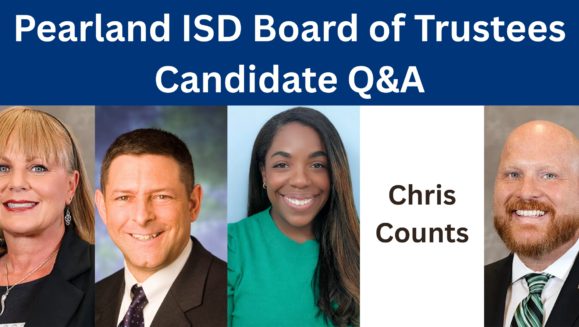
What knowledge, skills and experiences have prepared you to serve as an Pearland ISD Board Trustee?
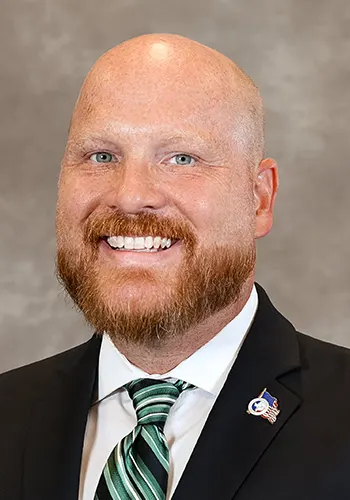
Besides the most obvious answer (I have been a trustee for Pearland ISD since 2020), both my professional and my personal life are relevant to the task.
• As a father of six school-aged children attending five campuses spanning all four grade bands in Pearland ISD, I have the broadest possible view of our district which a parent can have.
• As a veterinarian, I am a professional problem solver. I collect information, examine the problem, and generate solutions.
• I have been chairman of the Pearland Chamber of Commerce, so I understand what businesses are looking for in graduates entering the workforce. • I spent 10 years in higher education including as an instructor, so I know what it takes to achieve academically.
• I am a stakeholder and board member for the Northern Brazoria Education Alliance, I am active in the Pearland Lions Club, and I volunteer my time to educate high school students at Robert Turner High School, even performing live surgeries with student assistance.
• I have completed all required and even some voluntary training for school board governance, and I believe I have a comprehensive understanding of Pearland ISD. There is no training like the “on the job” training I have received these past six years.
That all comes with experience, something I can offer.
As a candidate for the school board, how will you ensure every student feels included, respected, represented, and protected—regardless of religion, sex, or disability—and how will you keep classroom instruction focused on academic learning and critical thinking rather than religious instruction?
I have been very outspoken that our schools need to educate children in the basics, not indoctrinate them into our biases. This cuts two ways, and “both sides” get upset when it goes against their priorities.
It is interesting that this questionnaire from the Democrats highlights a fear of children receiving religious indoctrination from the schools. A Republican questionnaire might ask something similar, albeit on a different topic (e.g., critical race theory).
Seeing that the majority of educators donate to Democrat-aligned causes, I would say the Conservative fears are justified. And seeing that Democrat children in the State of Texas attend public schools in a predominantly religious, Republican state, I can understand their fears as well.
I say all of this for one purpose: to highlight that NO ONE wants to send their children to school just to have educators indoctrinate them to their beliefs. Every student is entitled to a safe and inclusive education regardless of religion, race, socioeconomic status, physical ability, political orientation, heritage, background, etc.
But one must realize, this limitation is a two-way street. As strongly as you may feel about religious content in schools, other people feel about topics you hold dear.
If we walk the middle path of academic achievement and extracurricular excellence, we will keep the peace, and our students will get to forge their own ways. Religious and political instruction are the purview of the parent, and Pearland ISD will not usurp that role.
Schools face competing pressures — retaining teachers, sustaining extracurricular programs (athletics and the arts), educational excellence, and keeping class sizes manageable — all within constrained budgets. As a school board candidate, what specific approach would you take to balance these priorities so students receive high quality instruction and teachers are supported and retained?
You would be hard pressed to find a school district in Texas that has done a better job
of balancing these priorities than we have right here in Pearland ISD!
- According to the Texas Education Agency, we are one of only six “A”-rated districts in the Houston area.
- Not only are we high-achieving, but we have gotten there with tremendous financial stewardship as shown in our “A”-rating from the Financial Integrity and Rating System of Texas.
- We have set a district goal to raise teacher pay to stay competitive in both recruitment and retention, both of which are already exemplary. Strong culture is key.
- Our extracurricular activities (sports, fine arts, music, robotics, etc.) are the envy of every community in the state and even the nation.
- Pearland, Texas would not be the “Best Place to Live in Texas” (U.S. News & World Report, 2025-2026) without strong, vibrant schools as the bedrock. That is possibly the biggest appeal of the community.
It has not been easy. Our budget is mostly set for us by existing obligations, fixedoverhead costs, and a complicated state funding formula. Only 14% of our budget issemi-discretionary, and that word is being used loosely. This year, TEA revised ourfunding formula without notice and, just like that, $8 million disappeared. Thatmoney was for teachers and capital projects. But we cannot give what we do nothave. I feel strongly that we MUST fight to retain talent and experience in our district. To do so, we need reliable funding, a stable legislative environment, and the continued support of our community.
Recently, several books have been challenged or removed in our district and elsewhere. Parents already have the ability to opt their child out of individual books. As a school board candidate, what is your view on which types of books should be subject to removal from school libraries, and under what circumstances — if any — should the board override a library review committee decision to remove a title for all students? Titles often cited include: The Catcher in the Rye; Brave New World; Lonesome Dove; 1984; The Color Purple; To Kill a Mockingbird; Of Mice and Men; Beloved; The Bluest Eye; The Handmaid’s Tale; The Kite Runner; Maus; All Boys Aren’t Blue.
Let’s start where almost everyone agrees: not every book is appropriate for a school library. Not only is that the prevailing sentiment across the political spectrum, but it is also the law in the State of Texas.
School libraries are not public libraries. High school library patrons are children as young as 14 years old. And while parents can opt out of individual books, there is currently no way to opt out of entire genres or topics. The system is cumbersome, and most parents do not even know it exists. Simultaneously, many children read in the libraries without checking books out.
We agree that school library catalogs must be appropriately curated. The only question is where to draw the line. Hustler Magazine does not belong; The Cat in the Hat does. What about the ones that are less obvious?
For instance, we cannot provide sexual content to children, but even that line can be fuzzy. I would never want to see I Know Why the Caged Bird Sings (Maya Angelou) pulled due to the childhood trauma she describes, but All Boy’s Aren’t Blue (George Johnson) is significantly more explicit (read: illegal) and inappropriate for the demographic.
The gatekeepers are the librarians, but they represent just one opinion. The library review committee is 2 parents, 2 teachers, 2 librarians, and an administrator: better. The school board (professionals, educators, parents) has the final say; and yes, it is our duty to override decisions we find inappropriate. We represent the voters; no one else does. Why should the library review committee’s opinion be final when the process clearly says otherwise?
School libraries must engage sophisticated readers while protecting innocent children. It is a balancing act, and we are all called to participate.
Artificial intelligence tools are becoming more common in education, offering potential benefits and raising new concerns. As a school board candidate, what do you see as the productive uses of AI in our schools, and what risks or limits should the district address as the technology becomes more prevalent?
Artificial intelligence is the “one ring to rule them all” of our generation. The power and potential of this technology is undeniable! As happens with the adoption of every new technology, there are unintentional consequences that will ensue.
Children are already outpacing educators by using AI to complete homework assignments, and educators cannot reliably weed out the frauds. AI is in our homes, listening to our conversations, and making sure our every need is met (or exploited). So, what is the role of AI in schools? The answer is being fleshed out as we speak.
If you know anything about me, I am a self-described luddite technophile. I use technology every day, typically pushing the limits for my profession. It multiplies my productivity and efficiency (when it works). And I grew up in an age that was just witnessing the birth of the personal computer. How far we have come!
So why am I also a luddite? My experience is that children today know how to use apps, not computers. Consumer technology has become so intuitive that even their great-grandmothers have social media. Despite having computers in every backpack, I do not think our children are as computer literate as we think they are. They are computer dependent. And AI has the potential to make that worse, not better.
I would love to see students taught how to use AI to its full potential. Simultaneously, they need to be taught how they can be manipulated by artificial intelligence and “the algorithm.” As a class, they could learn about LLMs, APIs, and all the other acronyms of the trade. That could be fruitful if done right.
Intentional learning is what is needed, not simply the user experience of trying to plagiarize a research paper at the 11th hour.
Many students plan to enter the workforce directly after high school. Do you believe the district should expand vocational and career technical opportunities—including practical areas like personal finance—so students can graduate with strong, job ready skills? What role should the school board play in ensuring these pathways are accessible to all students?
YES! This! Please!
I mentioned that I serve on the board for the Northern Brazoria Education Alliance. Our focus is to support Career and Technical Education (CTE). Our organization was crucial in the formation of Robert Turner College and Career High School (RTCCHS), a first of its kind in the State of Texas. The thought was that not every child should go to college, and we needed a school that could offer CTE and vocational training to those that wanted it.
I helped design the veterinary student lab in RTCCHS. And every year I volunteer in that lab to perform spay and neuter surgeries on shelter animals with the assistance of students. Many of these kids want to enter my profession as technicians or doctors, and this is their first real taste.
We also bring students into our clinic as interns. Many other businesses do the same! HVAC, welding, pharmacy, culinary, nursing, EMS – there are so many career paths supported in Pearland ISD!
And what person would NOT have benefited from a course on personal finance? Or contracts and negotiation? Or buying a car? Or a house? Our community is a wealth of practical knowledge, yet we do not always pass it on.
Every child’s education should have practical application. Otherwise, they are just wasting time at a desk memorizing things they will never need. In Pearland ISD, we do what we can to make that a reality.
What do you feel are the top priorities for the Pearland ISD School Board within the next 3 years?
Pearland’s problem was once rapid growth. Now, Pearland ISD enrollment is trending down. While Pearland is a highly desirable community, the population of children in Pearland is not rising. With no end in sight as well as increasing competition in the educational sector, Pearland ISD is shrinking.
The problem is that our facilities were built to meet the needs we projected years ago but that never materialized. These facilities cost money for staffing and upkeep. If we cannot fill them sufficiently, we will be faced with consolidating and shuttering some campuses. The conversation is only just beginning, but it is a reality we must address.
As our enrollment shrinks, so does our budget. And the state legislature likes to radically change things up every 2 years, including funding. We have been good stewards of taxpayer funds, one of the few districts to consistently balance our budget. But that may become impossible unless something drastic changes.
Navigating these problems will require a measured, considerate approach. There is no solution that will make everyone happy. As we have done with previous rezoning issues (think Magnolia and Carleston Elementaries), we will do everything possible to listen to the public, consider all options, and chart an equitable path forward.
Remember, these are your schools. We are the stewards chosen to govern them. We serve you, your children, and our community as volunteers. We live here, pay taxes here, raise our families here, and have an equal share in the fate of our district.
I am accessible and will always respond honestly to good-faith questions, and I would appreciate your support.